Claude API vs AWS Bedrock Comparison: Which AI Platform Should You Choose in 2026?
Focus keyword: Claude API vs AWS Bedrock comparison
If you’re looking to build with Claude AI models, you’ve probably noticed something confusing: you can access Claude directly through Anthropic’s API, or through cloud platforms like AWS Bedrock, Google Cloud, and Microsoft Azure. Which option is right for your project?
This Claude API vs AWS Bedrock comparison will help you understand the practical differences between these platforms and make an informed choice based on your needs, existing infrastructure, and budget. We’ll also cover Google Cloud AI and Microsoft Azure alternatives so you have a complete picture of your options.
▶Previous tutorial : Model Migration Guide: How to Upgrade AI Models Step-by-Step
What’s the Actual Difference Between Claude API and AWS Bedrock?
For the latest official details, see Claude Code can be used directly with Bedrock and Vertex.
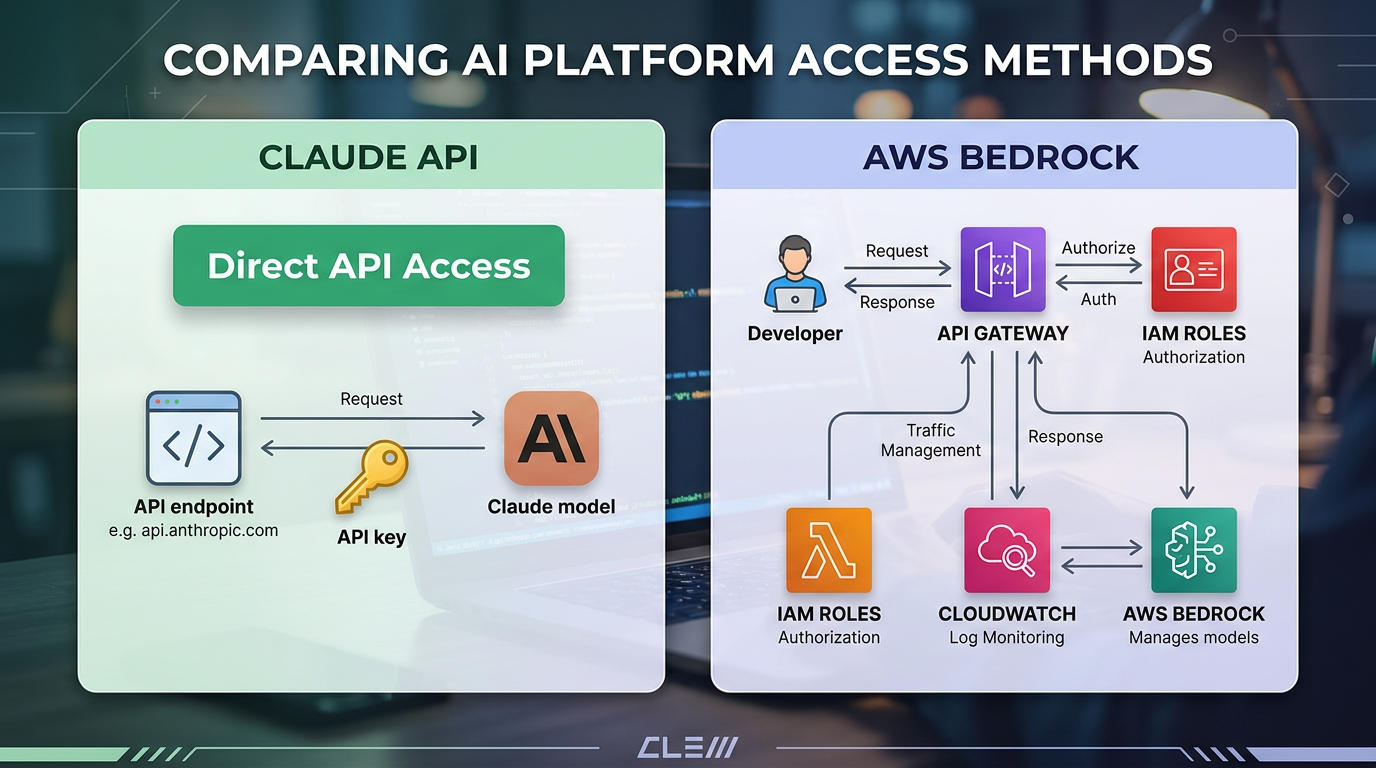
The fundamental distinction beginners often miss: Claude API means accessing Anthropic’s models directly through their API endpoint at api.anthropic.com, while AWS Bedrock is Amazon’s managed AI service that provides access to Claude models (and others) through AWS infrastructure.
Think of it like this: buying directly from a manufacturer versus buying through a large retailer. The direct API gives you straightforward access to Claude models with simple API key authentication. AWS Bedrock wraps Claude (and other foundation models) in AWS’s ecosystem, adding features like IAM role authentication, CloudWatch monitoring, and integration with other AWS services.
When using Bedrock or Google Cloud Vertex AI, your application doesn’t connect to api.anthropic.com at all—you’re calling AWS or Google APIs that handle the model inference on their infrastructure.
Who This Comparison Is For
This guide is designed for:
- Developers building AI-powered applications who need to choose an AI platform
- No-code builders evaluating which platform works best with their automation tools
- Technical decision-makers comparing costs and capabilities
- Anyone confused about whether to use Claude’s direct API or a cloud provider
You don’t need extensive cloud platform experience, but basic familiarity with APIs and REST endpoints will help.
Understanding Your Four Main Options
Option 1: Claude API (Direct from Anthropic)
Access Claude models directly through Anthropic’s official API. You create an account at Anthropic, generate an API key, and make requests to https://api.anthropic.com/v1/messages.
Best for: Simple projects, startups without existing cloud infrastructure, developers who want the most straightforward setup.
Option 2: AWS Bedrock
Amazon’s managed AI service offering multiple foundation models including Claude. Requires an AWS account and uses AWS IAM for authentication.
Best for: Teams already using AWS services, enterprises needing AWS compliance and security features, applications requiring multiple AI models.
Option 3: Google Cloud Vertex AI
Google’s AI platform that may offer Claude models through partnerships (verify current availability in official Google Cloud documentation, as model catalogs change frequently).
Best for: Organizations already invested in Google Cloud Platform, teams using Google Workspace integration.
Option 4: Microsoft Azure AI
Microsoft’s AI services platform, which may include Claude access through partnerships (verify current model availability in official Azure documentation).
Best for: Enterprises using Microsoft 365 and Azure infrastructure, organizations requiring Azure compliance certifications.
AWS Bedrock Pricing Explained: How Costs Actually Work
Understanding pricing is critical for making your choice. All platforms use token-based pricing, but the structures differ significantly.
Direct Claude API Pricing Structure
Anthropic charges per token for input and output separately. Pricing varies by model tier—Claude 3.5 Sonnet, Claude 3 Opus, and other available models have different rates. Check the official Anthropic pricing page for current July 2026 rates, as AI pricing changes frequently.
Simple example calculation: If you process 10,000 customer support conversations per month, averaging 500 input tokens and 300 output tokens each, you can calculate: (10,000 × 500 × input_rate) + (10,000 × 300 × output_rate) using current published rates.
AWS Bedrock Pricing Options
Bedrock offers two pricing models:
On-Demand Pricing: Pay per token, similar to direct API access, but rates may differ. You also need to consider potential AWS data transfer costs if your application runs outside AWS regions.
Provisioned Throughput: Reserve model capacity for consistent performance, paying an hourly rate regardless of usage. This makes sense for high-volume, predictable workloads but requires commitment.
Hidden Costs to Watch For
When using cloud platforms, factor in:
- Data transfer costs: Moving large amounts of data between regions or out of the cloud provider
- API Gateway fees: If you’re routing requests through AWS API Gateway or similar services
- Monitoring and logging: CloudWatch or equivalent monitoring tools may add costs
- Storage: If you’re storing conversation history or training data
Before choosing based on pricing alone, calculate your expected total monthly token usage and check current pricing for all platforms you’re considering. The cheapest per-token rate may not be the lowest total cost when you include infrastructure overhead.
Claude API Use Cases: When to Choose Each Platform
Choose Claude API Direct When:
- You’re starting a new project without existing cloud infrastructure
- Simplicity matters most—you want to make your first API call in minutes, not hours
- Your application is small to medium scale (under 100M tokens/month)
- You don’t need multi-model access or complex cloud integrations
- You prefer straightforward billing without hidden infrastructure costs
Practical example: A solo developer building a content writing tool that helps users draft blog posts. Direct API access gets you running quickly with minimal setup.
Choose AWS Bedrock When:
- You’re already running infrastructure on AWS (EC2, Lambda, S3, etc.)
- You need access to multiple AI models beyond just Claude
- Enterprise compliance matters—you need AWS security certifications and audit trails
- You want deep AWS integration like triggering models from Lambda functions or S3 events
- You’re building at scale with predictable high volume that benefits from provisioned throughput
Practical example: An enterprise customer service platform already using AWS that wants to add AI chat responses, route to different models based on query type, and maintain all data within AWS compliance boundaries.
Choose Google Cloud or Azure When:
- Your organization is already committed to that cloud ecosystem
- You need specific integrations with Google Workspace or Microsoft 365
- Data residency requirements align better with their regional availability
- Claude isn’t your only model need—you want access to their native model offerings
Getting Started: Practical First Steps for Each Platform
Quick Start: Claude API Direct
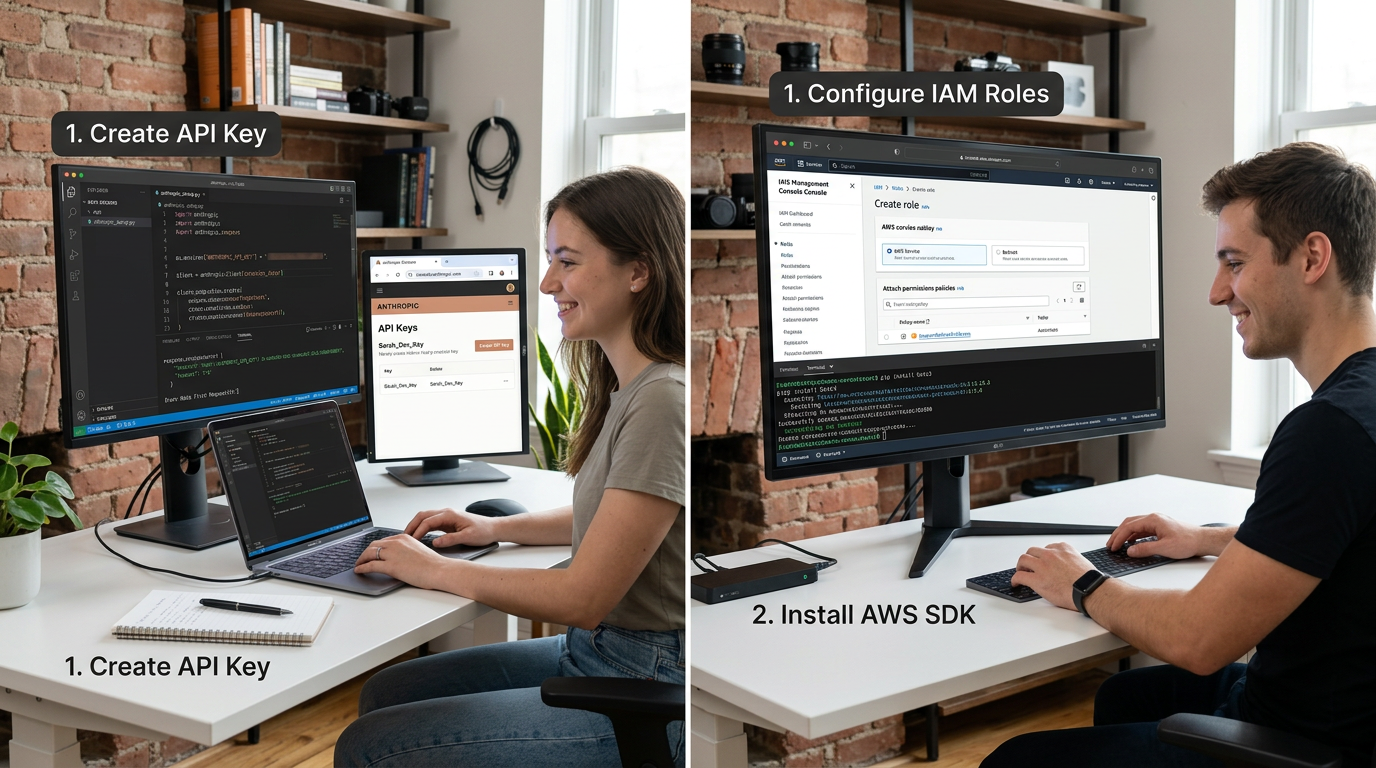
- Create an account on Anthropic’s platform
- Generate an API key from the API keys section
- Install the official Python or JavaScript SDK, or use direct HTTP requests
- Make your first request to the Messages API endpoint
Time to first working API call: 10-15 minutes
Prerequisite knowledge: Basic API concepts, ability to store API keys securely
Quick Start: AWS Bedrock
- Create or access an AWS account
- Enable AWS Bedrock in your region (check regional availability)
- Request access to Claude models (may require approval)
- Set up IAM roles or users with Bedrock permissions
- Install AWS SDK and configure credentials
- Make your first inference request through Bedrock API
Time to first working API call: 30-60 minutes (longer if new to AWS)
Prerequisite knowledge: AWS account management, basic understanding of IAM roles, AWS CLI or SDK experience helpful
Quick Start: Google Cloud or Azure
Setup complexity for Google Cloud Vertex AI and Microsoft Azure AI is similar to AWS—expect 30-60 minutes including account setup, service enablement, service account or managed identity configuration, and SDK installation.
Important: Before investing setup time, verify that Claude models are currently available on these platforms by checking their official model catalogs, as availability changes through partnership agreements.
Common Beginner Mistakes to Avoid
For the latest official details, see API provides a model-listing endpoint.
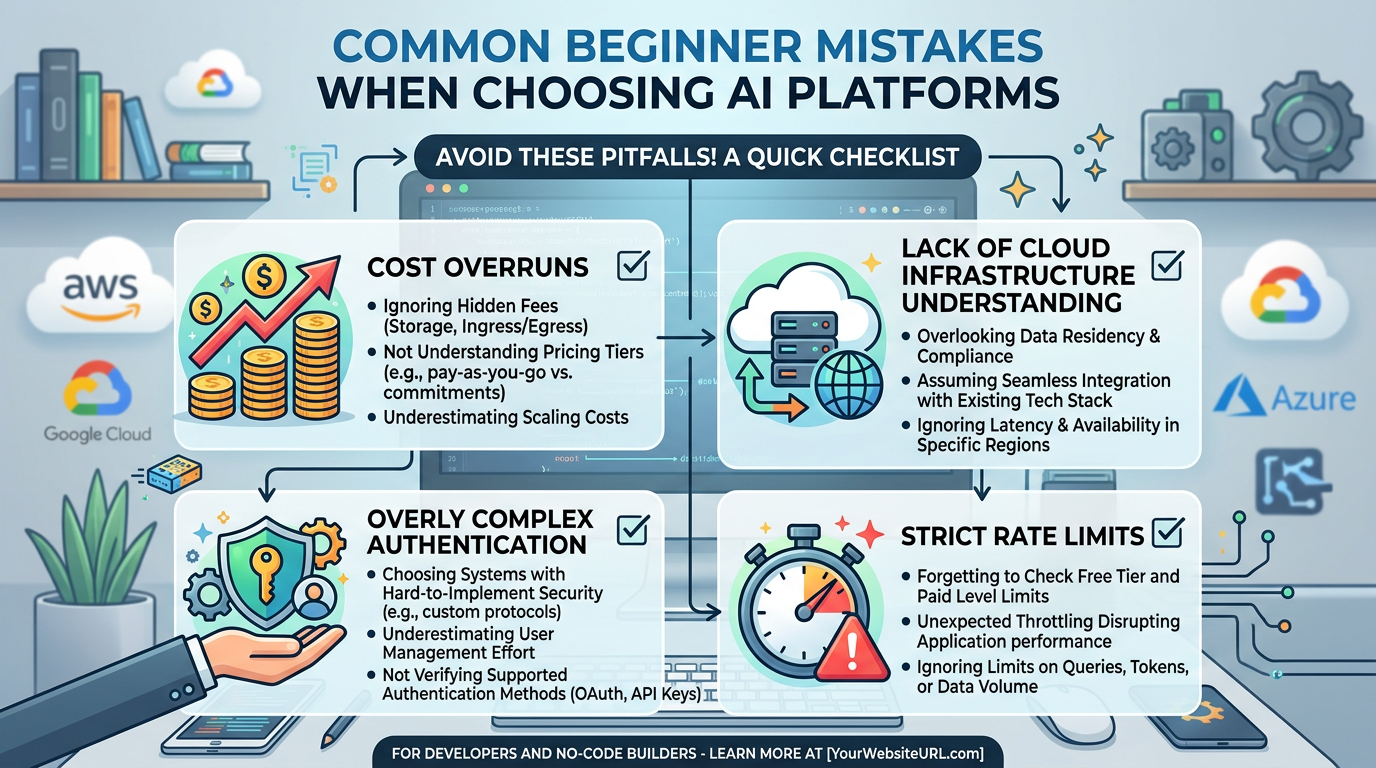
Mistake 1: Choosing Based Only on Per-Token Price
Why it’s wrong: The advertised per-token rate doesn’t include data transfer, monitoring, or the opportunity cost of complex setup. A slightly higher per-token rate with faster setup may be cheaper overall for your first 6 months.
Better approach: Calculate total cost including your time, infrastructure overhead, and expected token usage.
Mistake 2: Ignoring Your Existing Cloud Infrastructure
Why it’s wrong: If your application already runs on AWS, adding Azure AI for Claude access means managing multiple cloud accounts, separate billing, cross-cloud data transfer costs, and authentication complexity.
Better approach: Favor platforms that match your current infrastructure unless there’s a compelling reason to diversify.
Mistake 3: Not Testing Rate Limits Early
Why it’s wrong: You build your entire application, then discover the default rate limits are too low for your usage pattern. Increasing limits may require contacting support and waiting for approval.
Better approach: Check default rate limits on your chosen platform during the proof-of-concept phase. Test with realistic traffic patterns before launch.
Mistake 4: Overlooking Authentication Complexity
Why it’s wrong: Direct API key authentication is simple, but AWS IAM roles, Google service accounts, and Azure managed identities have learning curves. Underestimating this can block your project.
Better approach: If you’re new to cloud platforms, factor in learning time for authentication patterns, or start with direct API access and migrate later.
Mistake 5: Assuming Model Parity Across Platforms
Why it’s wrong: Not all Claude model versions may be available on all platforms simultaneously. AWS Bedrock, Google Cloud, and Azure may lag behind Anthropic’s direct API in offering the newest model releases.
Better approach: Use the official model-listing endpoints or documentation for your chosen platform to confirm which exact Claude versions are available before committing.
Google Cloud AI vs AWS Bedrock: Key Differences
While both are major cloud platforms offering AI model access, key practical differences include:
Model availability: AWS Bedrock typically has broader third-party model selection, while Google Cloud Vertex AI emphasizes Google’s own models plus select partners. Verify current Claude availability on both platforms before deciding.
Pricing structure: Both use token-based pricing but may include different minimum commitments or volume discounts. Check official pricing pages for your expected usage tier.
Regional availability: AWS generally operates in more regions globally. If you need data residency in specific countries, compare regional availability for both platforms.
Integration ecosystem: Choose AWS if you’re using AWS services; choose Google Cloud if you’re deep in the Google ecosystem (BigQuery, Google Kubernetes Engine, etc.).
Decision Framework: Which Platform Should You Actually Use?
Answer these questions to guide your choice:
1. Do you already use AWS, Google Cloud, or Azure for other services?
- Yes → Start with that platform’s AI offering to minimize authentication complexity and data transfer costs
- No → Consider Claude API direct for simplicity
2. What’s your expected monthly token volume?
- Under 10M tokens → Direct API is usually simplest and cost-effective
- 10M-100M tokens → Compare direct API vs cloud platform pricing carefully
- Over 100M tokens → Cloud platform with provisioned throughput may offer better rates
3. Do you need multiple AI models?
- Yes → Cloud platforms offer model diversity
- No → Direct API is simpler
4. What’s your team’s cloud platform experience?
- Experienced with AWS/GCP/Azure → Use what you know
- Limited cloud experience → Start with direct API
5. Do you have strict compliance requirements?
- Yes → Cloud platforms offer enterprise compliance certifications
- No → Both options work fine
FAQ
Can I switch platforms later if I change my mind?
Yes, but it requires code changes. Your API calls, authentication, and error handling will differ between platforms. Plan for 1-2 weeks of migration work for a medium-sized application. Keep your prompt engineering and business logic separate from API integration code to make future switches easier.
Do I get the exact same Claude model on Bedrock as the direct API?
Usually yes, but versions may differ. AWS Bedrock may take time to add newly released Claude models. Always check the available model versions on your chosen platform using their official model catalog or API endpoints.
Which platform has the best documentation for beginners?
Anthropic’s direct API documentation is generally clearest for beginners. AWS Bedrock documentation assumes familiarity with AWS concepts. Google and Azure documentation quality varies by service maturity.
Are there free trials or free tiers available?
This varies by platform and changes frequently. Check official pricing pages for current free tier offerings. Anthropic, AWS, Google Cloud, and Azure all periodically offer trial credits for new users. Confirm current promotions before committing to a platform.
What about data privacy—where is my data stored?
With direct Claude API, data is processed by Anthropic’s infrastructure. With cloud platforms, data stays within that provider’s regional infrastructure. For strict data residency requirements (like EU data must stay in EU), verify regional availability and data processing locations in official documentation for your chosen platform.
Next Steps: Start Building Today
The best way to make your final decision is to test your specific use case. Here’s a practical starting approach:
- Start with Claude API direct for your proof of concept—it’s the fastest path to working code
- Calculate your expected costs using real token counts from your prototype
- If you’re already on AWS/GCP/Azure, test the same workflow on that platform’s AI service
- Compare total costs including your setup time, infrastructure overhead, and per-token pricing
- Make your final choice based on total cost of ownership, not just advertised pricing
Remember that your initial platform choice isn’t permanent. Many successful projects start with direct API access for speed, then migrate to cloud platforms as they scale and need enterprise features.
Before following any setup steps, verify current pricing, model availability, and authentication requirements in the latest official documentation for your chosen platform. AI platforms evolve rapidly, and staying current with official sources ensures you’re working with accurate information.
The right Claude API vs AWS Bedrock comparison ultimately depends on your specific situation—there’s no universal “best” choice. Focus on what minimizes friction for your team while meeting your technical requirements and budget constraints.
Enjoyed this article?