
How to Become a Robotics Engineer: A Complete Career Roadmap for Beginners
Focus keyword: how to become a robotics engineer
Robotics engineering sits at the intersection of mechanical design, electrical systems, computer programming, and artificial intelligence. If you’re wondering how to become a robotics engineer, you’re considering a field that shapes autonomous vehicles, surgical robots, manufacturing automation, space exploration systems, and countless emerging technologies. This guide provides a practical, step-by-step roadmap from absolute beginner to job-ready robotics engineer, with realistic timelines and actionable advice for 2026.
Who This Guide Is For
This tutorial is designed for:
- High school or college students exploring engineering career options
- Career changers from software development, mechanical engineering, electrical engineering, or related technical fields
- Self-taught learners who want to understand both formal and alternative pathways
- International students researching educational requirements and career prospects
You don’t need prior robotics experience, but basic comfort with technology and problem-solving will help. If you’re completely new to programming or engineering concepts, don’t worry—we’ll outline where to start.
What Does a Robotics Engineer Actually Do?
Before diving into how to become one, understand what robotics engineers do daily. Unlike the dramatic robots you see in movies, most robotics work involves:
- Designing control systems that allow machines to sense their environment and make decisions
- Programming robot behaviors using languages like Python, C++, and frameworks like ROS (Robot Operating System)
- Integrating sensors and actuators to create perception and movement systems
- Testing and debugging physical systems that involve hardware, electronics, and software
- Collaborating across disciplines with mechanical engineers, electrical engineers, software developers, and domain experts
Robotics engineers work in diverse industries: manufacturing automation, autonomous vehicles, medical robotics, warehouse logistics, agriculture, aerospace, defense, and consumer products. The work combines computer science theory, hands-on hardware troubleshooting, mathematics, and creative problem-solving.
Educational Pathways: Formal Degrees vs. Alternative Routes
Traditional Four-Year Engineering Degree
The most common path is earning a bachelor’s degree in:
- Robotics Engineering (dedicated programs at institutions like Carnegie Mellon, Worcester Polytechnic Institute, and others)
- Mechanical Engineering with robotics concentration
- Electrical Engineering with focus on control systems
- Computer Science with robotics electives
Typical coursework includes calculus, linear algebra, differential equations, physics, programming fundamentals, electronics, control theory, kinematics, dynamics, embedded systems, and computer vision. Programs accredited by ABET (in the United States) or equivalent bodies internationally ensure consistent educational standards.
Timeline: 4 years full-time Pros: Structured curriculum, lab access, internship pipelines, credential recognition Cons: High cost (varies by country/institution), time commitment, less flexibility
Self-Taught and Online Learning Path
You can learn robotics fundamentals through online courses, tutorials, and personal projects. Major platforms offering robotics content include Coursera, edX, Udacity, and specialized robotics tutorial sites. Before enrolling, verify current course availability, pricing, and review recent student feedback since course catalogs change frequently.
Timeline: 6-18 months for foundational skills, ongoing for specialization Pros: Lower cost, flexible schedule, learn at your own pace Cons: Requires exceptional self-discipline, less structured guidance, credential recognition varies by employer
Hybrid Approach
Many successful robotics engineers combine a related degree (mechanical, electrical, software engineering) with self-taught robotics skills, online certifications, and project portfolios. This approach is increasingly common as the field evolves rapidly.
Important note: Some robotics positions, especially in regulated industries (medical devices, aerospace) or requiring professional engineering licensure, may require accredited engineering degrees. Research your target industry before committing to a path.
Essential Robotics Engineer Skills in 2026
Building a robotics engineering career requires both broad foundational knowledge and specific technical skills.
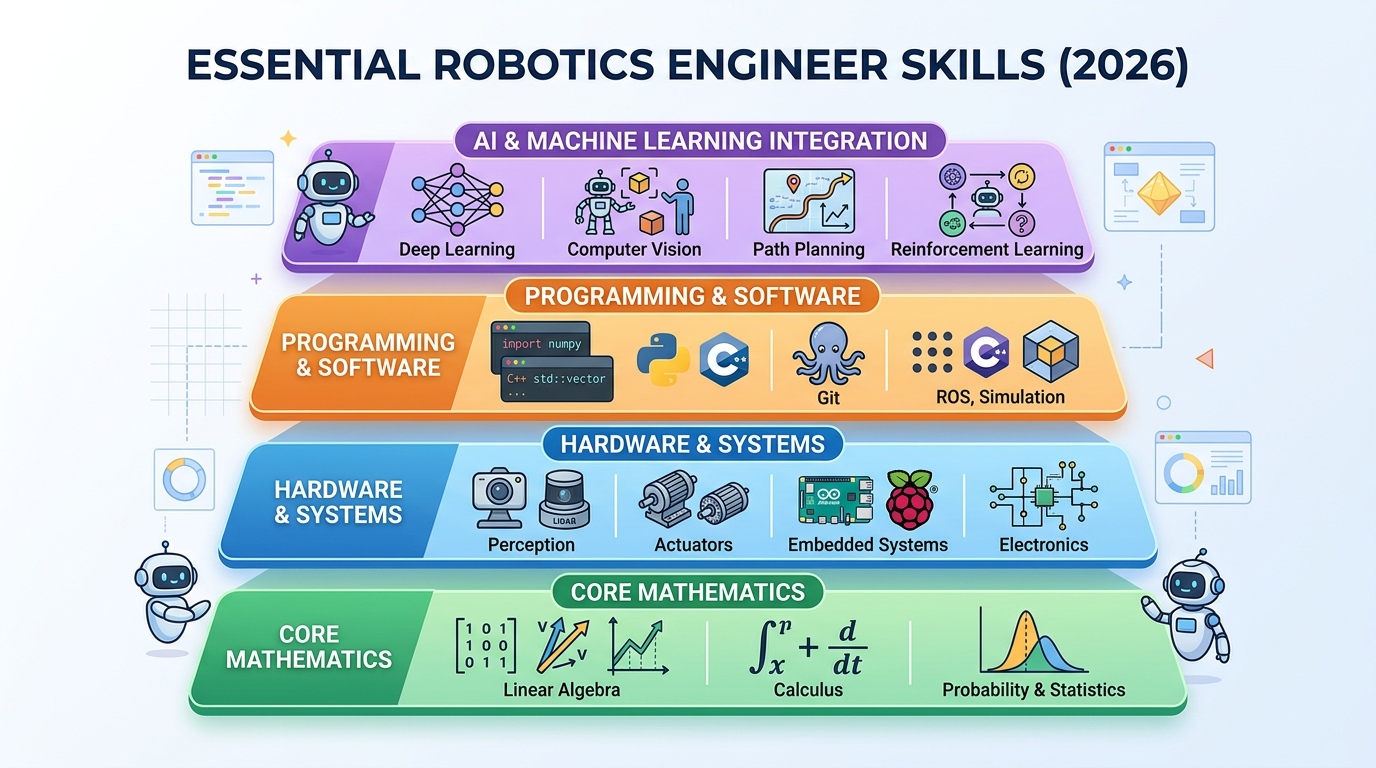
Programming Languages (Priority Order)
- Python – Most accessible entry point; widely used for prototyping, ROS nodes, machine learning integration, simulation scripting
- C++ – Essential for performance-critical robotics applications, real-time control systems, and production code
- C – Important for embedded systems and microcontroller programming
- MATLAB – Common in academic settings and control system design
Start with Python to build confidence and practical projects, then add C++ as you tackle more complex systems.
Mathematics You Actually Need
- Linear algebra – Essential for transformations, rotations, coordinate systems
- Calculus – Required for understanding dynamics, control theory, optimization
- Probability and statistics – Critical for sensor fusion, state estimation, machine learning
- Differential equations – Modeling physical systems and control design
Don’t let math anxiety stop you. You can learn these topics progressively as you need them, and many online resources make them more accessible than traditional textbooks.
Hardware and Electronics Fundamentals
Robotics isn’t purely software. You need understanding of:
- Sensors – cameras, LIDAR, IMUs, encoders, force sensors
- Actuators – motors (DC, servo, stepper), pneumatics, hydraulics
- Microcontrollers – Arduino, Raspberry Pi, and similar platforms for prototyping
- Circuit basics – reading schematics, voltage/current concepts, power management
- CAD software – designing mechanical components and assemblies
AI and Machine Learning Integration
In 2026, robotics increasingly incorporates AI for perception (computer vision, object detection), decision-making (reinforcement learning, path planning), and natural language interaction. Before relying on specific frameworks or tools, check current industry job postings and conference proceedings from ICRA and IROS to see what skills employers prioritize, as this landscape evolves rapidly.
Your Step-by-Step Robotics Engineering Career Roadmap
Phase 1: Build Foundations (0-6 months)
If you’re starting from scratch:
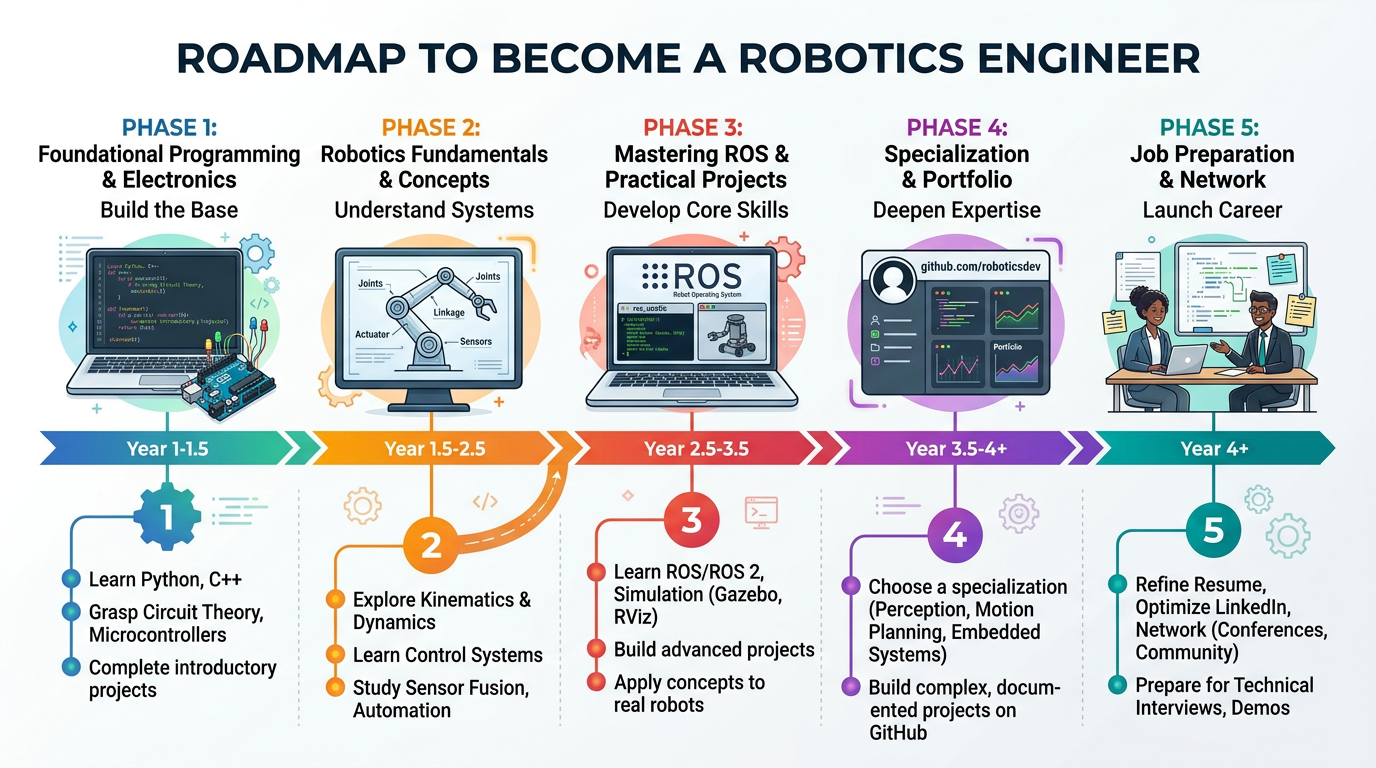
- Learn Python basics – Complete a beginner Python course focusing on syntax, data structures, functions, and object-oriented programming
- Study basic electronics – Understand voltage, current, resistance, basic circuits
- Start with beginner hardware – Get an Arduino or Raspberry Pi starter kit and complete introductory tutorials (verify current product availability and pricing before purchasing)
- Learn fundamental math – Review or study linear algebra and basic calculus if needed
Action item: Build your first simple project—a robot that avoids obstacles using an ultrasonic sensor, or a line-following robot. Document your process.
Phase 2: Core Robotics Concepts (6-12 months)
- Learn ROS (Robot Operating System) – Check official ROS documentation for the current recommended version and installation guides
- Study kinematics and dynamics – Understand how robots move and how to model that mathematically
- Explore control theory – PID controllers, state-space models, feedback systems
- Practice computer vision basics – Image processing, feature detection, camera calibration
- Build intermediate projects – Robotic arm with inverse kinematics, SLAM (simultaneous localization and mapping) implementation, autonomous navigation
Action item: Create a GitHub portfolio with well-documented projects including code, diagrams, videos, and explanations of your design decisions.
Phase 3: Specialization and Portfolio Building (12-18 months)
Choose an area of focus based on your interests:
- Autonomous vehicles – Path planning, sensor fusion, perception systems
- Manipulation – Grasping, force control, motion planning
- Human-robot interaction – Safety systems, collaborative robotics
- Medical robotics – Precision control, regulatory considerations
- Industrial automation – Reliability, scalability, integration with manufacturing systems
Action item: Complete 2-3 substantial projects in your chosen specialization. Make them public, write technical blog posts explaining them, and create demonstration videos.
Phase 4: Job Preparation (Ongoing)
- Apply for internships – Even if you’re self-taught, many companies value demonstrated skills
- Contribute to open-source robotics projects – Builds credibility and network
- Attend robotics meetups or conferences – Connect with professionals in the field
- Prepare for technical interviews – Practice explaining your projects, solving robotics problems on paper, coding challenges
Beginner Robotics Projects That Build Real Skills
Start simple and progress in complexity:
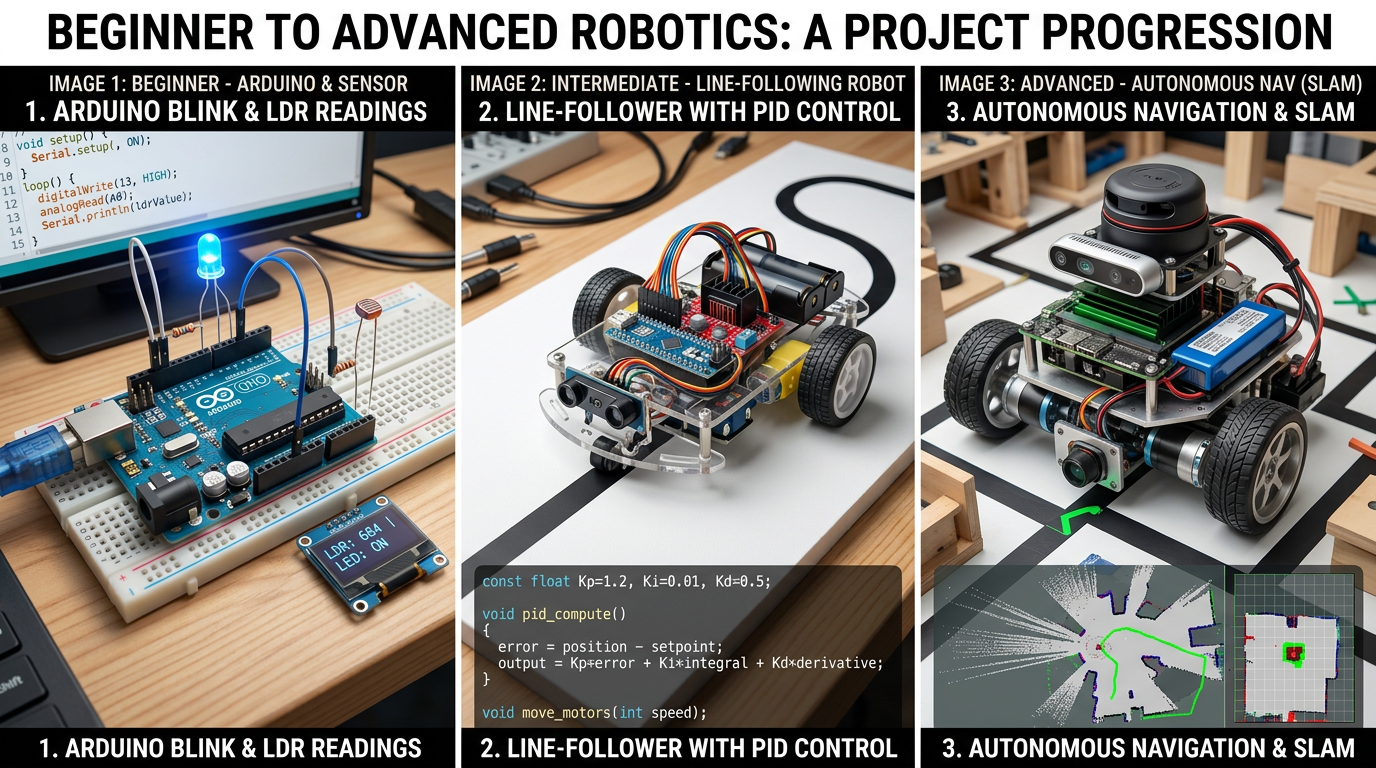
Beginner Level:
- LED blink and sensor reading with Arduino
- Temperature monitoring system with data logging
- Remote-controlled car using basic electronics
Intermediate Level:
- Line-following robot with PID control
- Robotic arm controlled via inverse kinematics
- Object detection and tracking using a camera
Advanced Level:
- Autonomous navigation using SLAM
- Pick-and-place system with computer vision
- Multi-robot coordination system
For each project, focus on documentation as much as implementation. Employers care about your ability to communicate technical decisions, troubleshoot problems, and build on previous work.
Best Online Courses for Robotics Engineering
Before enrolling in any course, verify current availability, prerequisites, pricing, and recent student reviews directly on the platform. Popular options historically include:
- Coursera – Robotics specializations from University of Pennsylvania and others
- edX – Robotics courses from Columbia, ETH Zurich, and more
- Udacity – Robotics Nanodegree programs (check current offering status)
- YouTube and free tutorials – Excellent supplementary resources for specific topics
Look for courses that combine theory with hands-on simulation or hardware projects. Completion certificates can supplement your portfolio but rarely replace degree requirements for regulated positions.
Common Mistakes Beginners Make
Mistake 1: Trying to learn everything at once Focus on one programming language, one hardware platform, and one project at a time. Depth beats breadth early in your learning.
Mistake 2: Skipping the math You can build simple robots without deep math knowledge, but you’ll hit a ceiling quickly. Invest time in linear algebra and control theory fundamentals.
Mistake 3: Not documenting projects Your GitHub repository with uncommented code and no README tells employers nothing. Write explanations, record videos, explain your thought process.
Mistake 4: Only doing tutorials Following step-by-step guides is useful initially, but employers want problem-solvers. Modify tutorial projects, add features, troubleshoot independently.
Mistake 5: Ignoring hardware fundamentals Software-focused developers sometimes struggle in robotics because they avoid electronics. You don’t need to be an electrical engineer, but understanding sensors, power requirements, and signal types is essential.
Mistake 6: Unrealistic timeline expectations Becoming job-ready takes time. If you’re starting from scratch with no engineering background, expect 1-2 years of focused learning for entry-level positions, longer for competitive roles.
Frequently Asked Questions
Do I need a specific degree to become a robotics engineer? Not always. Many robotics engineers have degrees in mechanical, electrical, or computer engineering rather than dedicated robotics programs. However, regulated industries and some countries require accredited engineering credentials. Self-taught paths exist but face more barriers.
How long does it take to become a robotics engineer from scratch? With a traditional degree: 4 years. Self-taught with intensive study: 1-2 years for entry-level readiness, though job placement may take longer. Career changers from related engineering fields: 6-12 months to acquire robotics-specific skills.
Can I learn robotics without expensive equipment? Yes. Start with simulation tools like Gazebo or CoppeliaSim (verify current versions and installation requirements). Basic Arduino or Raspberry Pi kits cost $50-150. Many skills can be developed through simulated environments before investing in hardware.
What’s the job outlook for robotics engineers in 2026? For current salary ranges, growth projections, and geographic demand, consult recent data from the Bureau of Labor Statistics (if available for your region), LinkedIn Salary, or Glassdoor, noting the collection date and region. Generally, automation, AI integration, and labor shortages continue driving demand.
Should I specialize or stay general? Early in your career, build broad fundamentals. Once employed or after completing 3-4 diverse projects, specializing in autonomous vehicles, medical robotics, industrial automation, or another domain helps differentiate you and deepens expertise.
Next Steps: Start Your Robotics Engineering Journey Today
Becoming a robotics engineer is achievable through dedication, structured learning, and hands-on practice. Here’s what to do this week:
- Assess your starting point – Do you have programming experience? Engineering background? Complete beginner?
- Choose your first learning resource – Pick one Python course or Arduino tutorial and commit to finishing it
- Join robotics communities – Find subreddits, Discord servers, or local meetups where you can ask questions
- Plan your first project – Even something simple like making an LED blink on command
- Set up your learning environment – Create a GitHub account, install Python, bookmark official documentation sites
The robotics engineering career roadmap isn’t linear, and everyone’s path differs based on background, resources, and goals. Whether you pursue a traditional degree, self-teach through online courses, or combine approaches, the fundamentals remain the same: strong programming skills, mathematical foundation, hardware understanding, and a portfolio of real projects.
Before relying on any specific tool, framework version, course offering, or degree program mentioned here, verify current details through official documentation and institutional websites, as the field evolves rapidly. Your journey starts with a single project—choose one and begin building.
Enjoyed this article?